..
.
.
STARFIRE TOR
FUTURE EVENT PRECOGNITION
TIME SHIFT TIME ARC BEGINS NOW
2010 FUTURE EVENT PREDICTIONS© Researched and Written By Starfire Tor
Posted December 31, 2009
http://blogs.myspace.com/starfiretorhttp://www.starfiretor.com/FEP/2010Predictions12-31-2009Report.htm
.
2010 PREDICTION #1
.
Initial Report
It is well known that earthquake scientists are not able to predict earthquakes with any accuracy. They readily admit this, because the earthquake science they work with doesn't come with enough useful information to form predictive capabilities. I am confident that my knowledge of Time Shift science can predict earthquakes in a way, and in a window of time, that scientists can't. Based on this December 31, 2009 to December 21, 2010 Time Shift arc, I've determined that there will be a significant uptick in earthquakes during this time. I'm in California, so I know that the earthquake uptick in California will be many times greater than usual. Earthquake scientists will admit this, but only guess at why this is. Major killer earthquakes will ravage the planet, and they will erupt in clusters. Activity on the sun will power up and at least one powerful geomagnetic storm will be entangled with a Time Shift, and powerful Time Shift created quakes. I can only hope that earthquake scientists will someday recognize that knowledge of Time Shifts - including Time Shifts and solar activity and geomagnetic storms - gives them essential knowledge about some earthquakes. Otherwise, these scientists will forever be left without much needed tools to protect and serve.
Results
Commentary
The 2010 Prediction # 1 has multiple hits. The Core Matrix, Time Shifts, and Co-Existing Time Lines represent interconnected devices, phenomenon, and events in which our reality and dominant current time line is constantly being edited and restructured. The Core Matrix acts as a core hard drive, where all of the programs and program elements for time lines are stored, accessed, and transmitted. The many time lines are actually time lines that exist in the same space, separately by frequency. This is why I refer to them as co-existing time lines, instead of referring to them as parallel timelines or parallel worlds. The brain is the interface to the Core Matrix, and a bio device that can download data, transmit data, and sustain the integrity of time line programs.
My research into this phenomena has yielded some fascinating information, including how to recognize information related to Time Shift events. I have recognized and developed Time Shift criteria. In many ways a Time Shift is like the wind. It’s a force that by itself is a natural energy that can’t be directly seen, but can be detected when it exerts it’s force on other objects like leaves. When we are outdoors, and we see leaves blowing around, we know that wind energy is doing that. Blowing leaves tells us that wind exists. Like the wind, a Time Shift can be detected when it exerts its energy and causes changes in the reality stored in our brains. One example of a changing reality, which reveals that a Time Shift has occurred, is a phenomenon called The Time Shift Living Dead. Read about Time Shift Living Dead, and you’ll understand why this enigma exists, and why it is evidence that a Time Shift has occurred. http://www.starfiretor.com/Articles+Reports/TSLD.htm
Another type of evidence, that a Time Shift has happened, is a time slip enigma. The best documented time slip in history is the one experienced at The Magic Castle in 2006, which was experienced by Whitley Strieber, Anne Strieber, and Starfire Tor.
http://www.starfiretor.com/TL-AnomalyMagicCastle-7-15-06.htmPrecognition is defined as an act of acquiring knowledge, of an event, in advance of the occurrence of that event. Through my research into Time Shifts, and related phenomena including psychic dreaming and precognition, I discovered the secret science of the dreaming and psychic brain. I was able to ascertain that the majority of precognition episodes are due to the brain’s interfacing with The Core Matrix, as the brain downloads bits of streaming data that from various co-existing time lines. The most common experience, of this brain-Core Matrix interface download, is experienced as dreams and waking visions.
What may seem to be a precognitive future event episode, in relation to the experiencer’s dominant time line, is actually a near current event in the co-existing time line where the info was obtained. This means that the brain is picking up streaming data from a co-existing time line program where the perceived events have already happened. The many timelines may be co-existing in the same space, but that does not mean that events in that time line are in perfect sync with all co-existing time lines. This makes a precognition episode a dual time line memory. The person recalls information that would seem to be in the future, when in fact it’s information obtained from a co-existing time line whose events are playing out at a different time. The brain usually becomes assimilated with the time line program, so that these things don’t happen. When they do I call it having a dual time line memory.
A Time Shift event can be detected by various criteria, just as a blowing leaf gives away the existence of the wind. One of those criteria is that certain earthquakes and other geophysical events. These events do not cause Time Shifts, but instead are caused by a Time Shift. One criteria, in a list of many criteria, has to do with solar activity. Some of this particular Time Shift criteria may prove that the solar activity itself helps to create Time Shifts. Some of the criteria may show that the Time Shift caused certain solar activity, and not that certain earthquakes cause Time Shifts. Therefore, certain earthquakes can be determined to be Time Shift caused earthquakes, by studying solar activity. Not all earthquakes are caused by Time Shifts, but some of the ones from 2010 are Time Shift related earthquakes.
One of the criteria I use in determining which earthquakes are Time Shift related, but certainly not the only criteria I use, is solar coronal holes. Coronal holes are areas where the Sun's corona registers as being darker, colder, and with lower density plasma than usual. Coronal holes are linked to unipolar concentrations of open magnetic field lines. The fast moving elements of the solar wind can travel along open magnetic field lines that pass through coronal holes.
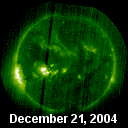
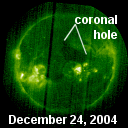
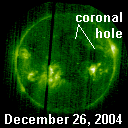
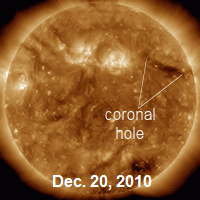
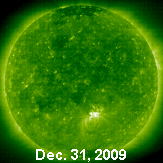
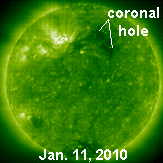
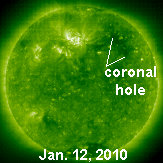
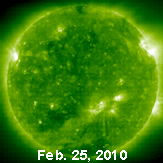
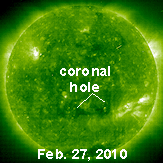
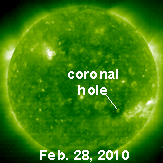
The photos below are of solar coronal holes, which are related to Time Shift related earthquakes and the Time Shift time arc going from December 31, 2009 to the December winter solstice of 2010. I’ve also included the coronal hole photo from December 2004, when the Indonesian earthquake and tsunami hit killings hundreds of thousands of people and animals. Note that days prior to that event, there was no coronal hole. But on the day there was. Check out the other coronal hole photos, and their corresponding dates to some large earthquakes. The Haiti killer 7 magnitude earthquake happened on January 12, 2010 – only twelve days after the start of the Time Shift time arc. Read the caption. It says “A solar wind stream flowing from the indicated coronal hole should reach Earth on Jan. 12th or 13th.” Now take a look at the huge 8.8 earthquake in Chile on February 27, 2010. It happened only three weeks after the Haiti earthquake. On that date there was also a coronal hole. But two days before the Chile quake there was no coronal hole. All of the quakes I pointed out are Time Shift related quakes. There is much more to document about this, and more will come later as the documentation is compiled and understood.
.
News Reports and Photos
.
There are no large coronal holes on the sun today. Photo NOAA's Solar X-ray Imager A solar wind stream flowing from the indicated coronal hole might hit Earth's magnetic field on Dec. 26th, but the impact will not likely spark bright auroras. Photo NOAA's Solar X-ray Imager Earth is glidng through a solar wind stream flowing from the indicated coronal hole. Photo NOAA's Solar X-ray Imager .
A weak solar wind stream flowing from the indicated coronal hole is buffeting Earth's magnetic field. Photo SDO/AIA. On December 31, 2009 there are no large coronal holes in the Earth-facing side of the sun. Photo NOAA's Solar X-ray Imager .
A solar wind stream flowing from the indicated coronal hole should reach Earth on Jan. 12th or 13th. Photo SOHO Extreme UV Telescope A solar wind stream flowing from the indicated coronal hole should reach Earth on Jan. 12th or 13th. Photo SOHO Extreme UV Telescope .
There are no large coronal holes on the Earth-facing side of the sun. Photo SOHO Extreme UV Telescope A solar wind stream flowing from the indicated coronal hole could reach Earth on or about March 2nd. Photo SOHO Extreme UV Telescope A solar wind stream flowing from the indicated coronal hole could reach Earth on March 1st or 2nd. Credit: SOHO Extreme UV Telescope ..
=======================================================
.
http://earthquake.usgs.gov/earthquakes/eqinthenews/2010/usc0000rxc/
Magnitude 7.4 BONIN ISLANDS, JAPAN REGION December 21, 2010http://earthquake.usgs.gov/earthquakes/eqinthenews/2010/usc0000rak/
Magnitude 6.5 SOUTHEASTERN IRAN December 20, 2010http://earthquake.usgs.gov/earthquakes/eqinthenews/2010/us2010tfan/
Magnitude 8.8 OFFSHORE MAULE, CHILE February 27, 2010http://earthquake.usgs.gov/earthquakes/eqinthenews/2010/us2010rja6/
Magnitude 7.0 HAITI REGION January 12, 2010
.=======================================================
.
http://en.wikipedia.org/wiki/Earthquakes_in_2010
Earthquakes in 2010 have resulted in nearly 250,000 fatalities. Primarily, the 2010 Haiti earthquake caused an estimated 230,000 deaths to that country, making it the 6th deadliest earthquake in recorded history. Also notable, the 2010 Chile earthquake registered a 8.8 on the moment magnitude scale, ranking it the fifth strongest earthquake since 1900. The tsunami associated with the Chile earthquake caused tsunami advisories and warning across the entire Ocean rim, also known as the Ring of Fire
.=======================================================
.
http://www.spaceweather.com/archive.php?view=1&day=12&month=01&year=2010
ACTIVE SUNSPOT: Sunspot 1040 is still growing. During the past two days it has doubled in size--and then doubled again--to produce an active region with more than 25 dark cores and a tangled magnetic field.
Sunspot 1040 is a member of new Solar Cycle 24, and its appearance continues a recent trend of intensifying solar activity. NOAA forecasters say there is a 15% chance of an isolated M-class solar flare during the next 24 hours.
.=======================================================
.
http://www.spaceweather.com/glossary/flareclasses.html?PHPSESSID=ejqupndktrirggppa1df5mejb2&PHPSESSID=62b59qq3c1ceektl8i8am9abn7
The Classification of X-ray Solar Flares
or "Solar Flare Alphabet Soup"A solar flare is an explosion on the Sun that happens when energy stored in twisted magnetic fields (usually above sunspots) is suddenly released. Flares produce a burst of radiation across the electromagnetic spectrum, from radio waves to x-rays and gamma-rays. [more information]
Scientists classify solar flares according to their x-ray brightness in the wavelength range 1 to 8 Angstroms. There are 3 categories: X-class flares are big; they are major events that can trigger planet-wide radio blackouts and long-lasting radiation storms. M-class flares are medium-sized; they can cause brief radio blackouts that affect Earth's polar regions. Minor radiation storms sometimes follow an M-class flare. Compared to X- and M-class events, C-class flares are small with few noticeable consequences here on Earth.
http://www.spaceweather.com/archive.php?view=1&day=12&month=01&year=2010
photo caption January 12, 2010 same day as Haiti quake
A solar wind stream flowing from the indicated coronal hole should reach Earth on Jan. 12th or 13th. Credit: SOHO Extreme UV Telescope
.=======================================================
.
http://www.spaceweather.com/archive.php?view=1&day=27&month=02&year=2010
A MONTH OF SUNSPOTS: February 2010 is on the verge of a three-year "first." It's the first month since January 2007 with sunspots every single day. It's been a long solar minimum, but solar activity is on the rise again. Today, NASA's STEREO mission is tracking at least six active regions around the circumference of the sun.
A solar wind stream flowing from the indicated coronal hole could reach Earth on or about March 2nd. Credit: SOHO Extreme UV Telescope
http://www.spaceweather.com/archive.php?view=1&day=28&month=02&year=2010
SPECTACULAR ERUPTION: A spectacular eruption is underway on the sun. SOHO is tracking a bright CME billowing upward from the vicinity of the sun's north pole: movie. Imagery from NASA's STEREO spacecraft show that this is a farside eruption, tilted away from Earth.
.=======================================================
.
http://www.spaceweather.com/archive.php?view=1&day=21&month=12&year=2010
TOTAL LUNAR ECLIPSE: Earlier today, for the first time in 372 years, a total lunar eclipse occurred on the date of the northern winter solstice. Observers in North America were favored with an overhead view as the full Moon slipped in and out of Earth's eerie red shadow. A weak solar wind stream flowing from the indicated coronal hole is buffeting Earth's magnetic field. Credit: SDO/AIA.
.=======================================================
.
http://www.suite101.com/content/earthquake-of-magnitude-74-strikes-japans-bonin-islands-a323638
A major earthquake of magnitude 7.4 struck close to Japan’s Bonin Islands on Tuesday 21 December 2010 Co-ordinated Universal Time, or 22 December local time (United States Geological Survey, “Magnitude 7.4 - Bonin Islands, Japan Region”, earthquake.usgs.gov). The islands are among several island groups which lie in the Pacific Ocean to the south of Japan and are located approximately 600 miles from the Japanese mainland.
The Earthquake of 21 December 2010
The earthquake occurred in the early hours of the morning: initial data published by USGS indicate that it took place offshore, around 150 km east of the settlement of Chichi-shima at a depth of approximately 15km. At magnitude 7.4, the earthquake is regarded as a major seismic event: it was followed by a series of aftershocks: at the time of writing, USGS had published information on six greater than magnitude 5.0.
Despite the intensity of the earthquake, its offshore location in a relatively sparsely populated part of the world meant that expected casualties were few and none had been reported at the time of writing. Early assessments indicated that fewer than 3,000 people were exposed to direct shaking and that the likelihood of structural damage was slight (USGS).
.=======================================================
.
http://www.space.com/spacewatch/monday-total-lunar-eclipse-moon-preview-101220.html
Tonight's Lunar Eclipse Comes With a Rare Twist
By SPACE.com Staffposted: 20 December 2010
A rare event not seen in 372 years will occur early Tuesday morning, when a total lunar eclipse coincides with the winter solstice. While you can't see the solstice, the eclipse promises to be an amazing spectacle.
And if that's not enough, a minor meteor shower is expected to send a few shooting stars through the darkened sky during the height of the eclipse.
Weather permitting, viewers in North and South America, as well as the northern and western parts of Europe, and a small area of northeast Asia should get a great view of the total eclipse of the moon.
On the East Coast of North America, the lunar eclipse begins half an hour after midnight on Tuesday; on the West Coast, it begins around 9:30 p.m. PST Monday. In all cases, the lunar eclipse will be observable before the moon sets in the west just as the sun is rising in the east. Maximum eclipse – the really cool part when the moon is totally in shadow – is at 3:17 a.m. EST/12:17 a.m. PST.
How it works
During a total lunar eclipse, the Earth gets between the full moon and the sun, blocking the sun's light from bouncing off the lunar surface. A lunar eclipse can only occur at full moon, but since the three objects are not all exactly in the same plane in space, not every full moon produces an eclipse.
Monday's eclipse is particularly special because it also aligns with solstice – the winter solstice in the Northern Hemisphere, and the summer solstice in the Southern Hemisphere. Winter solstice marks the official beginning of winter. The sun is at its lowest in our sky because the North Pole of our tilted planet is pointing away from it.
Winter solstice is also the shortest day of the year, with the longest night. That means that it should be darker Monday night than any other night this year in the Northern Hemisphere. And because of the lunar eclipse, the moon's light will be dimmed as well, meaning this night will be even darker.
Winter solstice has not coincided with a total lunar eclipse since 1638, according to NASA. Furthermore, the eclipse is falling during the Ursids meteor shower. These underappreciated shooting stars would likely have been outshined by the glow of the full moon occurring at the same time, but since the moon's light will be dimmed by the eclipse, stargazers should get a rare glimpse of the fiery lights created when small space rock bits burn up in Earth's atmosphere.
.=======================================================
.
http://www.space.com/scienceastronomy/solar-cycle-results-aas216-100614.html
Sun's Strange Behavior Baffles Astronomers
By Denise Chow
SPACE.com Staff Writer
June 14, 2010The sun's temper ebbs and flows on what scientists had thought was a pretty predictable cycle, but lately our closest star has been acting up.
Typically, a few stormy years would knock out a satellite or two and maybe trip a power grid on Earth. Then a few years of quiet, and then back to the bad behavior. But an extremely long stretch of low activity in recent years has scientists baffled and scrambling for better forecasting models.
An expected minimum of solar activity, between 2008 and 2009, was unusually deep. And while the sun would normally ramp up activity by now, heading into its next cycle, the sun may be on the verge of a weak solar cycle instead, astronomers said at the 216th meeting of the American Astronomical Society in Miami last month.
"We're witnessing something unlike anything we've seen in 100 years," said David Hathaway of NASA's Marshall Space Flight Center in Huntsville, Ala.
The sun's constant interaction with Earth makes it important for solar physicists to keep track of solar activity. Stormy periods can force special safety precautions by satellite operators and power grid managers, and astronauts can be put at risk from bursts of radiation spat out by solar storm. Scientists need to more reliably predict what's in store.
At the conference, four solar physicists presented four very different methods of measuring and tracking solar cycles.
The sun has spots
Sunspots are areas of concentrated magnetic activity that appear as dark dots on the solar surface. The ebb and flow of the sun's magnetic activity, manifested in the appearance of sunspots, make up the solar cycle.
Typically, a cycle lasts about 11 years, taking roughly 5.5 years to move from a solar minimum, a period of time when there are few sunspots, to peak at the solar maximum, during which sunspot activity is amplified.
The previous cycle 23's extraordinary minimum recorded the highest number of days without sunspots that researchers had seen since 1913, said Hathaway.
Hathaway and his team of researchers measured what is called the meridional flow, which is the circulation of stellar material from the sun's equator toward the poles and back again. This flow can often influence a cycle's strength.
The scientists examined the changes in the structure of the flow, and the levels of geomagnetic activity, as they corresponded to the minimums and maximums of the previous solar cycles.
"We found that there were variations in the strength of that flow," Hathaway said. "The last minimum in 1996, that velocity was about 11 meters per second (about 22 miles an hour), which is pretty slow for an object as big as the sun. That flow slowed down as we went to maximum in 2001."
The meridional flow then quickly increased again, and by 2004, it was faster than it was at the last maximum, said Hathaway. This flow continued to stay fast on the approach to this most recent minimum.
"My suspicion is that this sunspot cycle 23 was a weaker cycle than the last two, with fewer sunspots and weaker magnetic fields. These may feed into what happens with the meridional flow that is going to lead to another weak cycle."
Hathaway predicts that cycle 24 should reach its peak in mid-2013 at about half the size of the last three cycles.
The sun's out of sync
In a different approach, Sushanta Tripathy of the National Solar Observatory used the frequencies of acoustic oscillations to look for signatures of changes in the solar activity cycle.
Tripathy found that changes in acoustic frequencies were, for the most part, in phase with solar activity. But, during the extended minimum, he noticed that the frequencies of waves that cover a large portion of the solar interior became out of sync with solar activity.
"We find that the frequencies of sound waves that travel to the deep interior show an early minimum during late 2007, while the waves that are confined to near the surface show the signature of minimum in late 2008, nearly coinciding with solar activity minimum."
The two seismic lulls detected using acoustic oscillation have not been seen before in previous cycles, said Tripathy, leading researchers to conclude that the extended minimum between cycles 23 and 24 is quite unusual.
Jet streams on the sun
Frank Hill, also of the National Solar Observatory, took a separate approach, attempting to predict the sunspot cycle based on a phenomena on the sun that can be likened to solar jet streams.
This east-west flow on the surface of the sun was first discovered in 1980, and is known as "torsional oscillation."
The jet stream exists at a depth of at least 65,000 miles (about 105,000 kilometers) below the solar surface, and Hill and his team of researchers were able to examine its behavior at a depth of 600 miles (966 km).
"The position of the magnetic field is very highly correlated with the position of this flow," Hill said. "From helioseismology, we see the flows for two prominent cycles – Cycle 23, the cycle that we're coming out of, and Cycle 24, the cycle that we're in now."
It turns out that the flow appears well before the level that solar activity spikes. This led the researchers to conclude that there is some sort of triggering mechanism that appears before the onset of activity.
While observations of the solar jet could one day be useful for predicting the timing of the solar cycles, a larger data set is still required to ensure the method's accuracy.
"We're definitely going to need several cycles to improve the predictions," Hill said.
Further investigation will also be needed to determine whether the jet stream is a cause or effect of the solar cycle.
Our magnetic star
In yet another approach, Julia Saba of SP Systems and NASA's Goddard Space Flight Center in Greenbelt, Md., used X-ray and magnetic field strength indicators in order to predict the precise time mark for the onset of solar cycles.
Saba used magnetic maps of the sun, called synoptic charts, to observe solar cycles 21 through 23 and into 24. By evaluating trends in X-ray activity, Saba was able to predict the onset approximately 18 months ahead of time, and was accurate to within two months.
"By May of 2010, we see that cycle 24 is clearly underway, though things are still pretty quiet in the southern hemisphere in general," Saba said.
This method of determining a solar cycle's onset could be a valuable way to compare the different phases in solar activity because it can be observed in near real-time, Saba explained.
"It's a little easier to tell in real time than by solar maximum or solar minimum," she said.
While the four ways of monitoring solar activity take different approaches, the researchers are all in agreement that we are witnessing an interesting minimum. And while these methods could be useful for future studies of solar cycles, they all require further research.
"One problem we have with all solar cycle studies is the statistics of small numbers," Hathaway said. "Even with 23 sunspot cycles, it's not enough. What we've seen today are some newer measurements that weren't available even two cycles ago that are shedding new light. We need to be careful with using what we've seen from one or two cycles to make inferences for all of them."
.=======================================================
.
http://www.spaceweather.com/coronalhole.htm
Coronal Hole
Coronal holes are areas where the Sun's corona is darker, colder, and has lower-density plasma than average. These were found when X-ray telescopes in the Skylab mission were flown above the Earth's atmosphere to reveal the structure of the corona. Coronal holes are linked to unipolar concentrations of open magnetic field lines. During solar minimum, coronal holes are mainly found at the Sun's polar regions, but they can be located anywhere on the sun during solar maximum. The fast-moving component of the solar wind is known to travel along open magnetic field lines that pass through coronal holes.
Initial 2010 Prediction Report
..
.
Starfire Tor encourages the sharing of her material, found on her http://www.starfiretor.com website, in free sharing zones. Starfire Tor's material is copyrighted, and if shared with others must include the full title of the material, Starfire Tor's name as author and researcher, and the Starfire Tor web page of origin from this web site. Sharing Starfire Tor's material, without proper acknowledgement as stated, is an act of plagiarism. Please report any infractions, with URL, to Webmaster - Sharri Lorraine